Coffee with Ellie, Part I

I was asked to coffee by a beautiful girl once upon a time but unfortunately for me she just wanted to ask me questions of dance, photography, choreography and how they all relate to each other and actually didn’t want to talk about the weather, long walks on the beach or her favorite wine. We decided to meet at a local coffee shop which was ironic because neither of us drink coffee… anyhow, it was quite a lengthy interview so for your convenience I’ve decided to piece it into three separate posts.

Today, Part I: Technical Gibberish. Read on after the jump!


Ellie: Chris… I’m a huge fan of your photography and it’s nice to finally meet the man behind the camera. Let’s start out easy, what camera do you use?

Chris: Thanks Ellie! I love your earrings. Anyhow, I shoot digital exclusively with my Nikon D700. It’s a full 135-frame camera at a resolution of 12-megapixels which allows me to work in the theatre as well as the studio to produce the images I need when I need them. I don’t know of many other cameras that can do what the D700 is capable of, going from the studio on a tripod one day to shooting a wedding with a vertical-grip the next.

E: You shoot weddings?

C: I’ve shot a wedding [pauses]. Right, but the image quality even at higher ISO-sensitivities is nothing short of amazing and paired with Nikon’s best auto-focus system this camera has no boundaries and no limits to what it can shoot. One can deliberate the bullet points of cameras ad infinitum but it’s hard to quantify the results this camera produces. It just works.

E: Sounds like a great camera, but what’s your dream camera, no matter the cost?

C: In the studio I would be more than happy with a Phase One P 65+ or a nice Hasselblad.

E: Film?

C: [laughs] Never, digital lends itself to a process that cannot be had with film. I can get results quicker with less strain upon the dancers without spending a fortune on Polaroids but lord knows I still love me a Mamiya 6×7 loaded with Provia.

E: Hmm… I’m more of a Kodak girl myself.

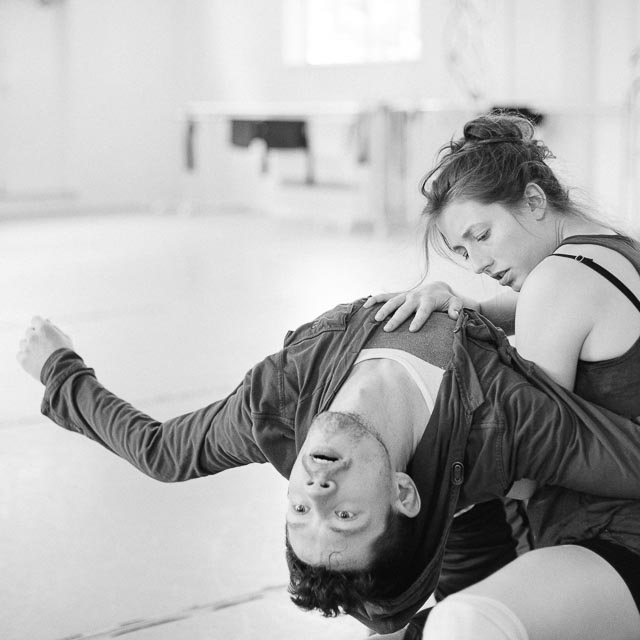
C: I do love Portra and Tri-X though. A lot of my work documenting dancers in the studio was shot on Tri-X and Ilford HP5 so I’ve adapted my processing style when shooting rehearsals in the studio to emulate those emulsions with digital.

E: Let’s talk lighting. What kind of lights do you use and how many?

C: With most of my work anymore I’m down to just a single light coming from a Paul C. Buff Einstein 640. Usually this is paired with a large and diffuse light modifier and I love the look and control I can get from a gridded softbox. More and more, however, I’m finding myself drawn to large specular modifiers like the 86” silver PLM. Next up is the possibility of a large silver beauty dish which has a bonus +5 to sparkle if I’m reading the stats right.

E: Paul C. Buff is fantastic, but have you considered other brands of flash?

C: Of course! The grass is always greener on the other side, right? In reality, finding the right family of modifiers with the right quality of light isn’t as easy as it would seem unless you’d like to go into cardiac arrest when you look at the price tag. Have a look at Broncolor, your face will melt-off.

E: Your work before the New Dance Project is so different from your previous work, namely the Studio 60 Project. Why the drastic change?

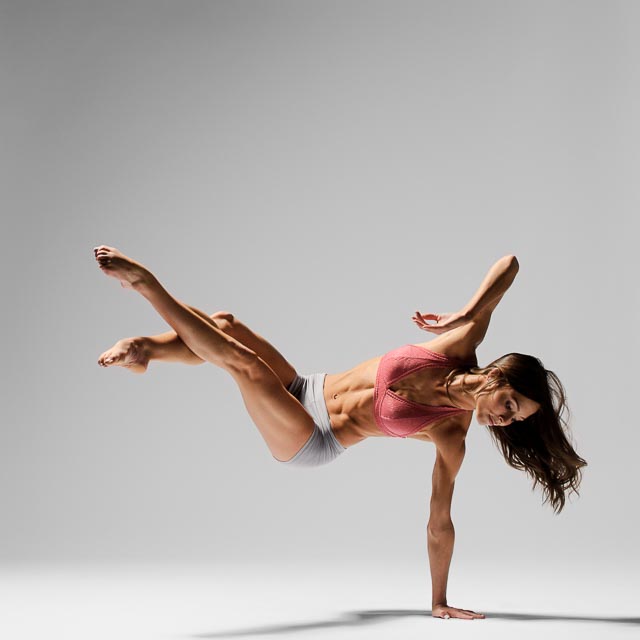
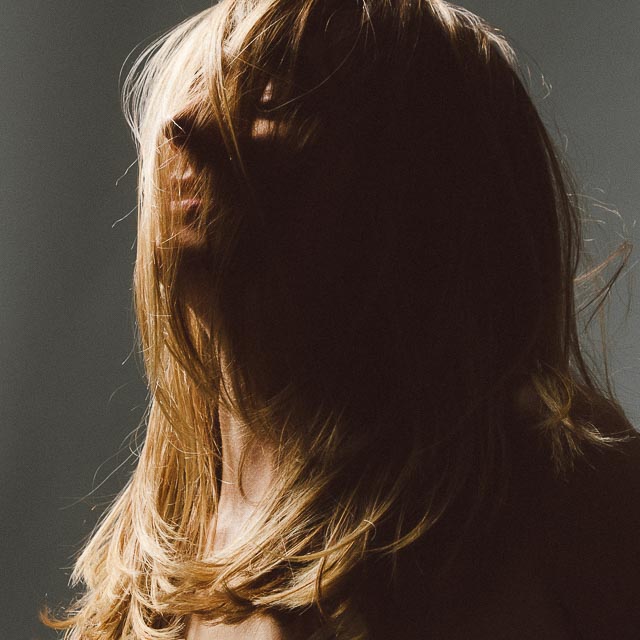
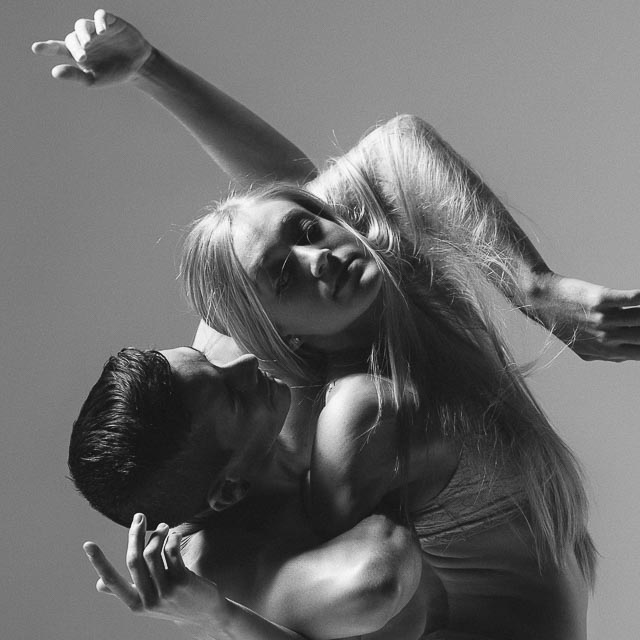
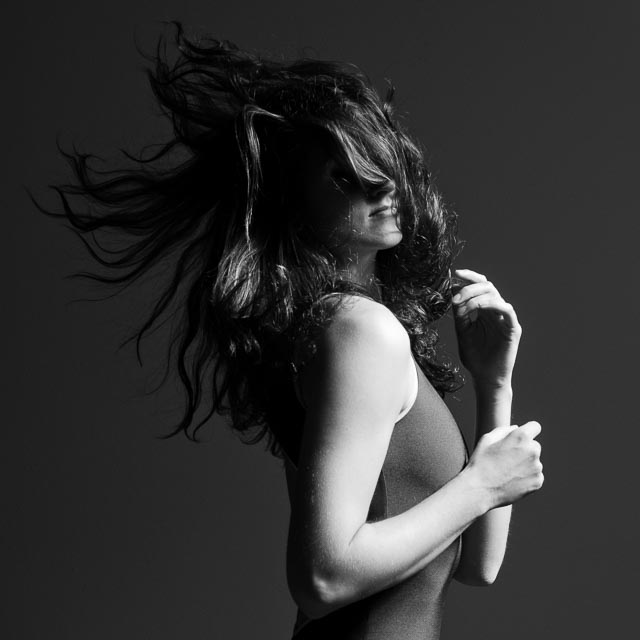
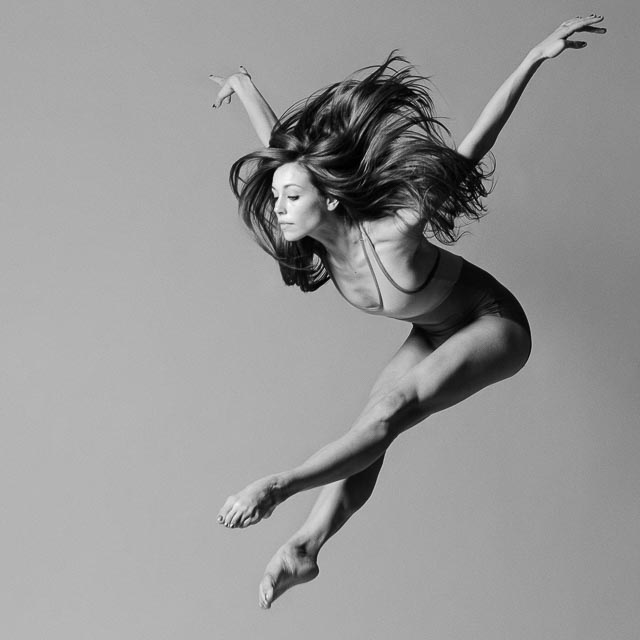
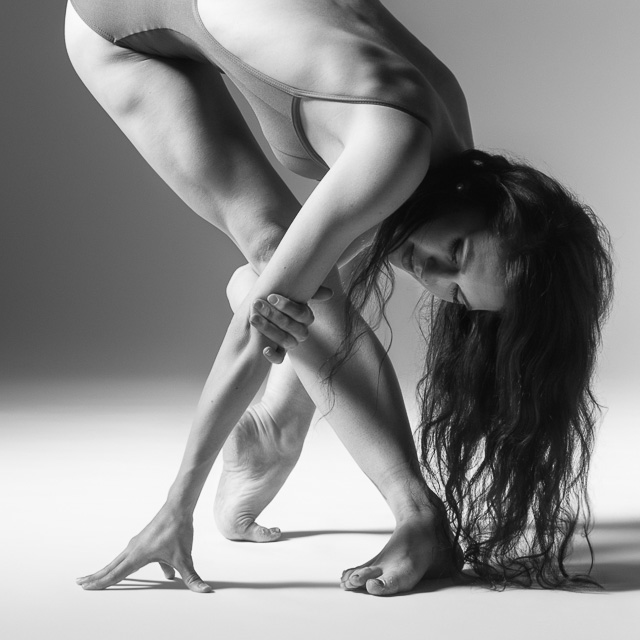
C: I worked on the Studio 60 Project for quite a while and the more I shot in that style and the more I further I developed my own voice, the more I realized I wanted and craved for something completely different, something remarkably simple. When I started what’s become the New Dance Project I gave myself the limitation of a single light source with only diffuse, soft light. I wanted to be forced into exploring the possibilities of dance and not of demonstrating my technical ability with light. I wanted to have the most deliberately boring light possible because I wanted the subject to speak for itself. I’ve had shoots with as many as six lights sources and getting back to basics was as liberating as it was difficult, there is no technical trickery allowing my dancers to look larger than life.

E: I watched your interview on [FRAMED] the other night and noticed you use a telephoto lens across the studio instead of close-in with a wide-angle. Was this a deliberate decision having tried every method or was it more driven by what kit you had at the time?

C: Telephoto lenses, which for me is my Nikkor AF-S 80-200mm f/2.8, have the quality of compressing the depth of an image and offer no distortion of the lines or limbs of the dancers. It’s very flattering to the subject and won’t make a hand look larger than we know it should. As with the transition from the Studio 60 Project to the New Dance Project, I wanted the simplest of means and telephoto was another limitation for myself.

E: So if I came upon an unspecified amount of money, what would camera, lens or otherwise would you recommend for me?

C: [under his breath] a D3X for me…

E: I beg your pardon?

C: I mean… you should find the best combination of bodies, lenses and auxiliary lighting you can afford depending upon what you want to shoot and how you want to shoot it. Buy once and don’t be afraid of the used market but just remember that the equipment doesn’t make the photographer just as much as Hilary Hahn’s violin doesn’t make the musician. Have you ever heard her play the violin?

E: More times than I’d like to think.

C: The Online Photographer had a great article about the buying dilemma which you can read here.

E: I’ve read that article before, very cheeky. Carrying on, how is it that you manage to capture the movement so clear when strobes sync at a maximum of 1/250 (ed: depending upon the model)? 1/250 isn’t very fast at all so are you using continuous light or a leaf shutter?

C: Nikon unfortunately doesn’t make any leaf shutter lenses but those sweet, sexy shutters can sync anywhere from 1/500-1/1600 depending upon the model where my particular camera with a focal plane shutter syncs at 1/250. Focal plane systems have a pair of curtains that control your exposure and 1/250 is the fastest speed that my camera (and most other SLRs) has both shutters open to accept the full exposure of a flash pulse. That speed is only really important when ambient light is contributing to exposure and in my studio work the entire exposure is dependent upon the flash pulse without ambient contributing at all.

E: But how does flash-sync work?

C: [waves his hands around in a foolish attempt to describe a modern focal plane shutter]

E: Umm…..k?

C: Fine, watch this video, it even explains flash duration.

E: So I work with flash. How come some of my images have blur-age?

C: Wells that’s because you need a faster t.1, Ellie.

E: A t-what?!

C: A flash pulse is really similar to a sound wave in that it has a very steep attack to full intensity with a longer and gradual slope or decay. Just as we hear all parts of a sound a photo is exposed during all parts of a flash pulse. You can think of it as a shutter speed within a shutter speed and the measurement standard for flash duration is in t.5 and t.1.

The flash I’m working with now allows me to stop the motion of the dancer around 1/3000 at the t.1 measurement standard and at that speed the t.5 duration becomes a bit meaningless because of the unusual method for controlling flash duration. It’s a strange flash and I think it has something to do with the ground up bits of unicorn horn in the flash tubes, but I may be mistaken.

E: But why’s that t.1 duration so important? The flash I have has a super-fast t.5. Isn’t that good?

C: Don’t believe the t.5 to be your ultimate ability to stop motion, it’s a trap! Most flash manufacturers list that speed because it sounds faster than it really is and only a few classy flash makers readily advertise that t.1 spec. At t.5 your flash has only discharged 50% of its power where at t.1 it has discharged another 40% of its power (to leave a remaining 10%, hence t.1). Nearly half your exposure is happening between that gap from t.5 to t.1.

Just as it is with a sound wave’s decay, it takes much longer to reach the point where the sound has diminished enough to no longer hear it. With a flash pulse that’s usually 3x the amount so if your flash has a listed duration of 1/1000 it’s safe to assume your t.1 is around 1/333 but it can be longer depending.

E: So how can I control that flash duration?

C: It depends upon how your flash is built as there are three main ways to control the waveform of the flash.

The first is via capacitor switching and here the flash unit just reduces the number of capacitors active at any one time. This method is found in the majority of studio packs and a very few monolights. Here, less power equates to a faster flash duration.

The second is almost universal across the board with monolights (and a few packs, looking at you Elinchrom _) and that’s voltage reduction. This actually takes the wave form and diminishes its power but lengthens the flash pulse as a result. Odds are, if you own a monolight (or an Elinchrom pack _) it’s fastest flash duration is at maximum power.

The third is IGBT which is how all shoe-mount flashes work as well as a few packs from Broncolor (namely their Scoro and Grafit packs) and the Einstein that I use. What’s interesting about IGBT is that instead of changing the length of intensity of the waveform, it simply chops off the wave’s tail end which in turn affects the intensity and duration. Measuring t.1/t.5 is a lot different with this particular method of flash control and that, again, has to do with the chopped up bits of unicorn horn located within the flash tubes.

E: Why do you keep glaring at Elinchrom?

C: Because they have one of the best families of light modifiers and location battery packs at prices that don’t induce an aneurism but none of their packs approach a usable t.1 which for me is at least 1/2000. Their Ranger RX Speed AS comes closest in their line, I’ll give it a whirl eventually so I can stop with the look of disapproval.

E: OK, that’s enough geek talk. Let’s talk about shooting outside the studio. Do you have any technical advice for shooting live performances?

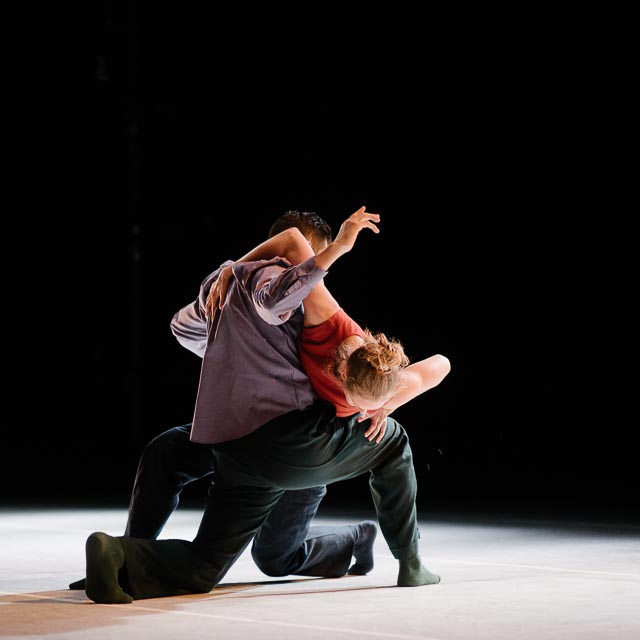
C: Fast lenses and saying your prayers for a light designer who doesn’t get too dim nor over-saturated with the colors. This will never happen, by the way.

E: That’s encouraging…

C: Oh it’s not that bad. The way I’ve shot live performances for years is to spot-meter skin-tones and set my exposure manually. Theatres tend to freak out your camera’s meter and ideally I would have an assistant next to me with a spot meter calling out exposures to me every time a light changes. In this regard, you have to be very aware of what’s happening during the piece as light designers and choreographers usually want new light cues to segue to a new phrase or sentence in the piece.

E: How do you capture the right moment in a live performance if you don’t know the piece?

C: Catching the dancer during a peak moment takes time and practice. Watch enough dance and then photograph enough dance and you will eventually get used to the natural rhythms of dance and dancers and their respective timings.

E: So what should I take with me to my next live performance?

Depending upon the venue and where you’re allowed to shoot from, you’ll want fast f/2.8 zooms, usually a mid-range and a telephoto, and hopefully a pair of fast f/1.4 primes, usually a 50mm and an 85mm. If you’re in a proscenium space you’ll likely be glued to your telephoto zoom but if you’re in a studio theatre it’s just the opposite with you mid-range zoom instead.

E: One of my classmates is also a fan of yours and wanted me to ask if you if she could use your photo for one of her classes. Would that be okay?

C: Probably, but she should send me an e-mail first.

E: I’ve seen some of your photo’s on tumblr blogs! That’s pretty sweet, right?

C: I’m just going to go into this corner over here and cry myself into next week, thanks.

E: Come back! I don’t understand…

C: Just visit tumblr and check out the vast amounts of attribution.

E: Okay, no tumblr then. If we didn’t know each already, how could I work with you?

C: If you were a dancer living in the pacific northwest, you would just have to shoot me an e-mail with an outline of your resume. If you were looking to assist you’d be terribly bored once I’m set up. If you were looking for mentoring, I can work one-on-one and am eventually looking to start teaching workshops as well. In either case, you would shoot me an e-mail to get the details from me.

E: What’s your post-processing like?

C: Fairly simple, really. I ingest, convert, tag and do all the global adjustments like cropping, white balance and tone curves in Lightroom anymore. After that the image goes into Photoshop where I work on more local adjustments like unsharp masks, dodging, burning and the like. Another special sauce that Photoshop does are duo-, tri- and quadtones. These add a beautiful richness and inky quality to grayscale photos that black and white conversions do not.

For the New Dance Project, I gave myself the limit of nearly zero retouching. I promised myself I wouldn’t touch the dancer and would only convert in a vein similar to Ilford HP5 Plus. Here, I only work on the backdrop to make it less textured so that more attention is paid to the dancer and nothing else. I went through a major film phase a few years ago and became obsessed with the negative and the idea of its permanence, I wanted to somehow project and display only the negative and that limitation played a huge part in my head in determining how to approach a new dance project.

E: Do you ever fix the dancers at all?

C: Never. The dancers I choose to work with are some of the best dancers in the world, getting it right during capture is easy when you have that kind of talent to work with.

E: Can I buy a print from you?

C: [looks around] Here? Now? You want a mosaic of coffee beans?

E: You’re frustrating, you know that?

C: [smiles] I know. I’ve thought about putting a storefront on my website but there’s not been too much demand. Perhaps if you got together some friends and demanded such a thing it could be done. My rates aren’t too steep, I’d rather have my work being enjoyed versus being payed a large sum for a single piece. Regardless, if you want a custom print you should e-mail me and we’ll discuss.

E: Do you have a favorite lab?

C: For custom and gallery work, West Coast Imaging is the best in the business. I still shoot a bit of film and will now be sending my work off to Richard Photo Lab, their work is incredible. I love the look and feel of film and always will but I’ll admit that I can’t scan film worth a damn, that is some hard work and a complete mystery to me.

Alright, that’s enough for this week! Stay tuned for next week’s installment: Dancers, an instruction manual.

Posted in Archived and tagged with , . RSS 2.0 feed.

Leave a Reply

Your email address will not be published. Required fields are marked *

You may use these HTML tags and attributes: <a href="" title=""> <abbr title=""> <acronym title=""> <b> <blockquote cite=""> <cite> <code> <del datetime=""> <em> <i> <q cite=""> <strike> <strong>